English Medium Sample
Clear question numbers, proper paragraph spacing and simple headings.
Get your IGNOU assignments professionally handwritten, neatly prepared as per university guidelines and delivered to your doorstep. Order online from expert IGNOU writers.


Avoid last-minute delays —
order your assignment early.
View three original GSPH handwritten assignment sample photographs. Check the writing style, clarity, page layout and overall presentation before requesting your course-specific material.
Clear question numbers, proper paragraph spacing and simple headings.
Readable handwritten answers with well-separated sections and neat presentation.
Student, enrolment, programme and course details organised in one place.
Clean, readable and consistent writing style.
Well-structured content with proper layout.
Real samples to help you understand the expected presentation.
Looking for an IGNOU handwritten assignment? GSPH Publication offers two ways to request course-wise handwritten reference material: a scanned digital PDF you can study on your phone, or a physical handwritten hard copy you can read on paper. Both options are designed to help you understand the writing style, layout and answer presentation. Choose the format that matches how you prefer to study, and confirm your course code, language and session before ordering.
Get a clear scanned digital version of handwritten assignment reference pages. Open it on your phone, laptop, tablet or computer, zoom in to understand the handwriting and view the question-wise format. It is convenient for students who prefer digital reading or need reference material without waiting for a courier delivery.
Ask for the correct IGNOU course code, assignment session, language, sample pages and included questions before confirming the order. Your PDF should match your selected subject. Digital reference material is separate from the original assignment you prepare and submit to IGNOU.
Prefer studying with actual paper in front of you? A handwritten hard copy is a physical set of handwritten academic reference pages. You can inspect the writing style, margins, headings and page organisation while preparing your own IGNOU assignment. The paper format is useful for students who find full-size printed or handwritten pages easier to read.
Share your course code, academic session, preferred medium and delivery PIN code. GSPH can confirm whether the physical reference material is available, what is included, the total cost and the expected dispatch arrangements. Courier or office collection should be confirmed before payment.
Choose a scanned handwritten PDF when you want to read the available reference on a digital device, zoom into handwritten answers and avoid the need for physical shipping. Choose a handwritten hard copy when you prefer reading and comparing full-size paper pages while preparing your own responses. The academic content you require should be confirmed for the same course code and assignment session regardless of format. Neither option is automatically an approved IGNOU submission.
For example, a student looking for an English-medium BEGC course may prefer PDF access for mobile reading, while a student who studies away from a screen may prefer a physical sample set. The right format depends on reading preference, page availability, turnaround needs and overall cost—not on a difference in IGNOU evaluation marks.
| What matters to you | Scanned Handwritten PDF | Handwritten Hard Copy |
|---|---|---|
| How you receive it | Digital file after confirmation | Physical pages by courier, if available |
| How you use it | Read, zoom and study digitally | Read from paper while preparing your own work |
| What to verify | PDF sample, course, session, language | Actual sample, course, delivery and packaging |
| Price structure | Course-specific quote | Course-specific quote plus possible shipping |
| University submission | Not automatically valid to submit | Not automatically valid to submit |
The total depends on the course code, academic session, medium, page count and reference format. Therefore a generic “starting at” price can mislead students when the selected course is unavailable or needs a different number of pages. The order form collects the necessary details so the GSPH team can share a specific quote before payment. For hard copies, the quote should make courier charges and the destination PIN code clear. Do not rely on an unconfirmed delivery date or a claimed discount.
Before paying, ask the team to confirm: (1) course code and assignment validity, (2) medium, (3) a representative sample, (4) number of pages or content coverage, (5) total payable amount, (6) delivery method and (7) applicable cancellation/refund conditions. This is a practical checklist for avoiding wrong-course orders.
Choose your format, share course and contact details, then review and send your enquiry on WhatsApp.
For many students, the difficult part is not handwriting alone. The real challenge is choosing the correct question paper, understanding what each answer requires, organising the pages and submitting everything by the appropriate deadline. This guide follows the order in which a student would actually complete the work, with simple examples and practical checks.
Begin with the programme you are enrolled in and the exact course code shown on your academic records. For example, BEGC-131 and BEGC-132 are different courses even though their codes look similar. A mistake of one digit can mean preparing answers for the wrong subject. Check the assignment code and validity period on the current official question paper, and compare it against the exam session for which you are preparing.
Download the question paper from the official IGNOU website or its assignment service rather than relying only on an old file shared in a student group. IGNOU assignment booklets may cover different sessions, and some programmes use schedules that differ from the general cycle. Do not decide validity from the PDF filename alone.
Check how many questions must be attempted, whether internal choice is given, the marks for each question and the expected word limits. Pay attention to commands such as discuss, explain, distinguish, critically examine and write short notes. They ask for different kinds of responses. A discussion needs connected arguments; a comparison needs clear points of difference; a critical examination should recognise strengths and limitations with appropriate reasoning.
Mark the compulsory questions first. If the paper asks you to answer any two out of four, there is no need to write all four unless specifically instructed. Doing extra work does not guarantee additional marks. Make a small checklist of the questions you need to complete before you start the final handwritten version.
Use your IGNOU study blocks and relevant authoritative references to understand the topic. Identify the main definition, arguments, examples and conclusion. Avoid writing an answer that simply repeats the question in several different ways. For a longer answer, a sensible structure is a short introduction, clearly developed discussion and a concluding paragraph that answers the actual question.
Example: If a question asks you to explain secularism in India, define the idea first, then explain its constitutional and social context, and finally present the relevance and challenges with appropriate examples. The goal is clarity, not filling pages. Write your responses in your own words; reference samples are useful for understanding structure but are not substitutes for independent work.
A4-size paper is prescribed for many IGNOU assignments, though students should follow their particular programme instructions on paper type. Use clean sheets, allow reasonable margins and keep spacing consistent. Blue or black ink is a practical choice for most handwritten work. Avoid extravagant decoration, oversized headings, unnecessary highlighter use and hard-to-read handwriting.
Write the question number exactly as it appears in the question paper. Place an informative heading where useful, separate paragraphs clearly and label any diagrams. If you make a small error, correct it neatly rather than obscuring several words. When an answer needs 500 words, aim to address the required topic within approximately that range instead of expanding it to many pages without substance.
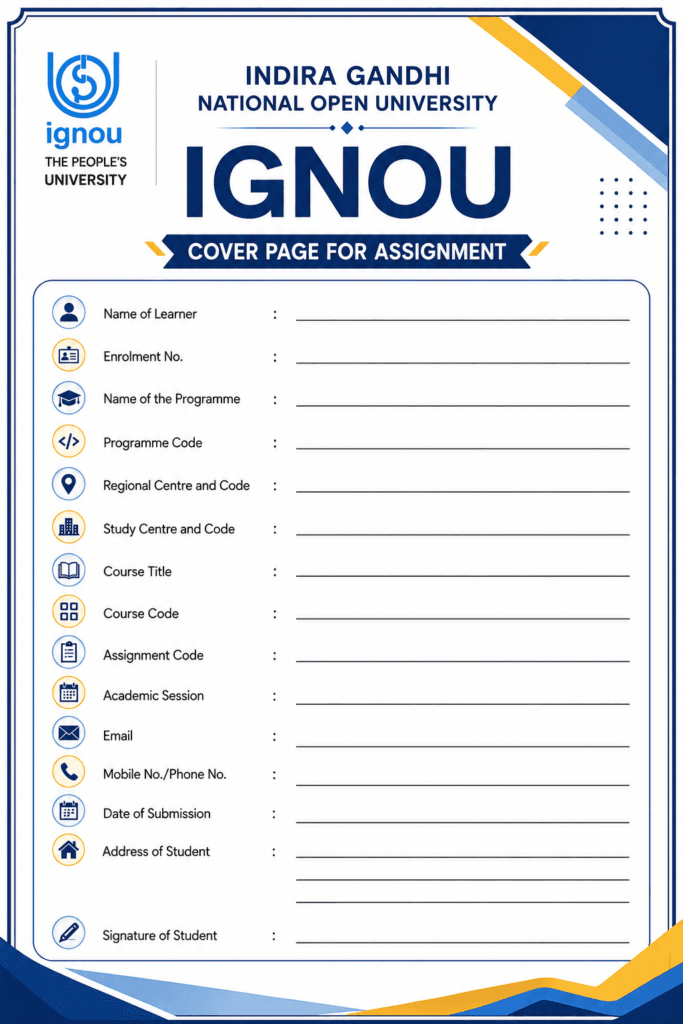
Your cover page should identify the student and course unambiguously. Typical details include name, enrolment number, programme, course code, assignment code, Regional Centre or Study Centre, session, date and signature, depending on the relevant official instructions. Use the same information that appears in your IGNOU records. Leave space for any official receipt or marking area when your prescribed format requires it.
Prepare a separate set of answer sheets for each course. Some Study Centres or programme instructions ask students to attach the assignment question paper or additional identification; others do not. Therefore, treat the order cover page → question paper (where required) → supporting document (if requested) → handwritten answers as a useful organising example, not as an unconditional university-wide rule.
Before submission, check that every required question is answered, the course code is correct, page numbers are complete and the cover page matches your enrolment details. Ensure that no answer page is missing or upside down. If your centre permits digital submission, scan pages in good lighting, crop them neatly, check readability and create the files in the format and size specified in the official instructions.
Do not upload through a general WhatsApp number or an unofficial Google Form unless the relevant IGNOU authority has expressly authorised that channel. Retain your original files and a submission acknowledgement; these become important if your assignment marks are not reflected later.
A good front page is not a decoration. It ensures that the assignment can be associated with the correct student, course and Study Centre. If your programme publishes a prescribed front-page format, use it. Otherwise, use a clean layout that contains the details requested by your centre.
Student identity: Full name, enrolment number and contact details where requested. Make sure the enrolment number is written carefully; transposed digits may delay identification.
Academic details: Programme code, course code and title, assignment code/session, Regional Centre and Study Centre name or code. A subject name without its exact course code may not be enough.
Submission details: Submission date and signature, along with any other field expressly required by IGNOU. Do not print personal details of another learner or leave last year's information on a recycled cover sheet.
Page arrangement: Keep pages in the intended sequence, provide question numbers and use separate answer sets for each course. A question-paper copy and ID-card copy should be attached when officially requested, not assumed compulsory everywhere.
Wrong paper: the question paper does not match the active session; wrong code: the cover page and answers have different course codes; missing question: a compulsory answer is skipped; poor scans: part of the handwriting is cut off in the PDF; no acknowledgement: the learner has no record of where and when the assignment was submitted. These are avoidable preparation and record-keeping mistakes.
Before leaving your home or uploading the PDF, keep a clear copy of the cover page, final answer pages and the official submission confirmation. This record can help when checking the grade card or discussing a missing mark with your Study Centre.
A common reason students order the wrong reference material is that they search only by programme name. For example, “BA assignment” is too broad because one programme can include many different courses. Always provide the full course code, assignment session and medium so the correct material can be checked.
BA, BCom, BSc, BBA, BCA and related undergraduate programmes may have different core, elective and skill courses. Two students in the same programme may need different assignment question papers. Share each exact course code instead of sending only the programme title.
MA, MCom, MBA, MCA and other postgraduate programmes generally require more detailed, analytical answers in many courses. Always check whether your question asks for an essay, critical analysis, comparison or short note, and use the corresponding word limit.
Shorter programmes can have specialised assignments and submission schedules. Programme availability and the correct session should be confirmed individually rather than guessed from general IGNOU calendars.
For a useful response, send the programme code, exact course code, your assignment session, preferred medium and whether you want a Scanned Handwritten PDF or a Handwritten Hard Copy. For a physical order, add the destination PIN code. If a particular question-paper version is important, mention the assignment code or share its official identification details. The team should verify availability before taking payment.
Examples of how to write a clear enquiry: “BEGC-131, English, applicable 2026–27 assignment, scanned reference PDF” or “MMPC-001, English, physical reference copy, delivery to my PIN code”. These are examples of enquiry formatting, not availability claims.
Check my course with GSPH →Assignment preparation is only one part of the process. The submission method and deadline matter just as much. There is no safe universal rule that every student must submit paper files at the centre or that every student can upload PDFs online. The correct method comes from the applicable programme, Study Centre, Regional Centre and official announcements.
Where offline submission applies, visit your designated Learner Support Centre/Study Centre with the organised assignment set. Confirm the centre's instructions about the cover page, file type, supporting documents and timing before travelling. Hand over the papers using the required procedure and request an acknowledgement or stamped receiving slip where issued. Retain it with your course details and submission date.
If you have transferred to another Study Centre, verify that the transfer is officially reflected in your records before submitting elsewhere. Giving the assignment to an unrelated centre may lead to avoidable tracking difficulties.
Where online submission has been permitted, follow the exact instructions issued for your programme and centre. Check whether the submission must be one file per course, whether a specific file name is required, and what PDF size limits apply. Use an official authorised portal, email address or submission form only. Save the upload receipt, successful submission screenshot or confirmation email, as applicable.
The format in which GSPH may supply a scanned reference PDF is separate from whatever IGNOU permits for students' own assignment submissions. Do not confuse buying a digital reference with submitting a university assignment.
IGNOU deadlines are associated with the applicable Term-End Examination, programme and session, and may be modified by university notices. Some courses have different assignment validity periods. Check the current assignment booklet and relevant official notifications instead of assuming that an old September or March deadline is still applicable. Missing a valid deadline can delay evaluation or affect examination-related eligibility, so confirm the correct course requirement early.
The latest authoritative source is ignou.ac.in, including official assignment downloads and your Regional Centre communications. GSPH is an independent resource provider and cannot issue or change university submission rules.
Submission does not always mean marks will appear immediately. Evaluation and record updates take time. If marks remain missing after a reasonable period, collect your enrolment number, course code, submission acknowledgement and date, then contact the Study Centre or Regional Centre concerned. Avoid automatically resubmitting a new assignment without checking whether your original submission was received and processed.
Passing marks also vary by programme; a common threshold quoted for some courses must not be treated as a universal rule. Your current programme guide is the correct place to verify the evaluation requirement.
Students should know exactly what they are asking for before placing an order. This page provides a course-wise enquiry form for two formats of handwritten academic reference material. It does not take online payment through the form, and an enquiry alone does not reserve a product or confirm dispatch.
Choose the format and enter your programme, course codes, medium and assignment session. If you are ordering hard-copy reference pages, give a complete delivery address and PIN code. A clear request saves time because the team does not have to guess which academic session or subject you need.
Request an actual handwriting sample and verify that it matches the product being offered. Confirm exactly which questions or pages are included, whether the medium is correct, and whether the quoted amount includes all relevant charges. For a physical copy, confirm dispatch and delivery terms before payment. If a course is unavailable, a truthful unavailable response is more useful than an unverified promise.
Handwritten reference material can help explain presentation, layout, answer organisation and writing approaches. It does not replace a student's obligation to prepare original responses under IGNOU's rules. GSPH Publication is an independent academic resource provider and is not officially affiliated with IGNOU.
Send one enquiry with all required subjects. Ask for the sample, price and relevant delivery details before making a payment.
Need a clear answer about handwriting rules, front-page details, scanned PDFs, deadlines or hard-copy requests? Find the complete guidance below, organised by topic.
Write your assignments in your own handwriting, follow the correct question paper, use the paper format specified for your course, prepare separate course-wise answer sheets, and submit them using the method approved by your Study Centre or Regional Centre. Keep submission proof and verify the current deadline on the official IGNOU website.
IGNOU students should prepare their assignments in their own handwriting, using the paper size prescribed in the course booklet (often A4, sometimes foolscap). Make separate answer sheets for each course, complete the required student details and write the correct question numbers. Attach a question paper or ID copy only if your course or Study Centre requires it. Submit before the official deadline at your allotted Study Centre, or through an officially permitted online route, and keep the acknowledgement receipt.
Official assignment instructions take priority over general tips. There is no universal rule requiring identical sheet order, pen colours or document attachments for every programme.
Yes. IGNOU requires students to write their assignment answers in their own handwriting for courses that prescribe handwritten submissions. Typed, printed or copied answers are not accepted where these instructions apply. Write the answers in your own words after studying the relevant course material. Copying another student’s work may result in rejection or loss of marks.
A4-size paper is recommended and specifically required in many IGNOU assignment instructions. Some courses prescribe ruled sheets, while others may permit plain paper. Use clean, good-quality sheets with suitable margins. Avoid unnecessarily decorative paper and check your course-specific instructions before preparing the final assignment. Note that some official booklets specify foolscap paper instead of A4.
A properly completed cover page helps the evaluator identify your assignment. Include the following details wherever required: Student Name and Enrolment Number; Programme Code and Course Code; Course Title and Assignment Code; Regional Centre and Study Centre details; Student Address and Contact Information; Academic Session, Submission Date and Signature. Make sure the details match your IGNOU student records.
Some IGNOU courses specifically require students to attach the assignment question paper. Others instruct students to write each question or question number before the answer. A useful file arrangement, where required, is: (1) Completed Assignment Cover Page, (2) Assignment Question Paper, (3) IGNOU ID Card Copy, if requested, (4) Handwritten Answer Sheets. The exact document order is not universal. Follow the instructions of your programme and Study Centre.
Generally, no. Prepare a separate set of answer sheets for each assignment or course code. For example, if you have four different subjects, organise four separate assignment sets with their respective course details. This makes identification, evaluation and record maintenance easier.
Blue or black ink is a sensible choice for clear, professional handwritten assignments. You may use consistent headings, underline important points and maintain readable handwriting. There is no need to use different pen colours for every heading or answer unless your course instructions specifically require it.
Arrange your pages in the correct sequence, number them properly and tie or bind them securely. A simple tag-thread binding or file arrangement is generally practical. Follow any specific instructions issued by your Study Centre regarding file covers, plastic folders or document packaging.
Yes. Students should follow the suggested word limits mentioned in their assignment questions. For example, if a question asks for approximately 500 words, prepare a relevant answer around that length. Focus on a clear introduction, logical explanation, appropriate examples and a meaningful conclusion. Writing unnecessarily lengthy answers does not automatically increase marks.
There is no single fixed page count for all IGNOU assignments. The total number of pages depends on the questions, prescribed word limits, handwriting size and diagrams. Focus on answering every required question properly rather than attempting to fill a predetermined number of pages.
You should use an assignment question paper that is valid for your programme, admission cycle and applicable examination session. Some IGNOU assignments remain valid across more than one admission cycle. Check the validity instructions printed on your assignment and verify the latest available question paper before writing.
Students should write assignments in a language permitted for their programme or course. Many IGNOU programmes provide English and Hindi options, but this is not universal. Check your programme’s medium of instruction and assignment instructions before selecting a language.
For standard physical submission, IGNOU students generally submit completed assignments to their allotted Study Centre or Learner Support Centre. If the relevant Regional Centre or programme has officially authorised online submission, students should follow those instructions. Always verify the correct submission method before the deadline.
Yes, when the relevant IGNOU authority officially permits online assignment submission. Students should scan their handwritten pages clearly and upload them according to the prescribed file format, size and submission instructions. Do not assume that every Regional Centre accepts assignments through email or Google Forms.
Use a mobile scanning application or document scanner to capture every handwritten page clearly. Arrange the scanned pages in the correct order, ensure that the writing is readable and save the document as a PDF. Where a separate PDF is required for each course, do not combine different subjects into one file. Check the prescribed file size and naming instructions before uploading.
Missing the prescribed assignment deadline can affect your eligibility for the relevant Term-End Examination or delay completion of the course. Check whether IGNOU has announced an official extension. If the deadline has passed, contact your Study Centre or Regional Centre for the applicable next submission opportunity. You should not assume that a missed deadline will automatically be extended.
The minimum passing marks depend on the programme and applicable evaluation rules. Several IGNOU bachelor’s programmes use a 35% passing requirement, while many master’s programmes require 40%. However, these figures should not be treated as universal for every programme. Check your current programme guide for the exact passing criteria and assignment evaluation requirements.
First, check whether your assignment has been evaluated and whether sufficient processing time has passed. If the marks remain missing, contact your Study Centre or Regional Centre with your enrolment number, course code, submission date and acknowledgement receipt. You can also check the official IGNOU grade card and assignment status facilities for updates.
Students should normally submit their assignments to their officially allotted Study Centre. If IGNOU has approved a Study Centre transfer or issued special submission instructions, follow the updated directions. Do not submit to an unrelated centre without confirmation.
IGNOU generally does not charge a separate fee for ordinary assignment submission at the designated Study Centre. However, Term-End Examination fees, project-related fees or other applicable university charges are separate. Check the current official fee notification rather than relying on an old examination fee amount.
Visit the official IGNOU website and review the latest announcements, assignment question paper and Regional Centre notifications. Assignment deadlines may vary according to the session, programme and subsequent extensions. Always verify the current deadline before preparing or submitting your assignment.
A Scanned Handwritten PDF is a digital reference document containing scanned images of handwritten pages. It can be viewed on a mobile phone, tablet or computer. A Handwritten Hard Copy is physical handwritten reference material supplied on paper, subject to availability and delivery arrangements. Both formats can help students understand handwriting presentation, answer structure and formatting. Students must prepare their own submission work according to IGNOU rules.
Select your preferred format—Scanned Handwritten PDF or Handwritten Hard Copy—and complete the order request form on this page. Enter your name, WhatsApp number, programme, course code, academic session and preferred medium. For physical copies, provide the delivery address. Submit the request through WhatsApp. GSPH Publication can then confirm availability, price and delivery arrangements.
The price depends on the course code, number of pages, language and selected format. Scanned Handwritten PDFs and physical handwritten copies may have different prices. Courier or packaging charges may also apply to physical deliveries. Enter your course details in the order form to request the current price and availability.
Students can enquire about available handwritten reference samples in Hindi and English. Samples are useful for understanding page presentation, question numbering, headings and handwritten answer formatting. Availability depends on the selected course and language. Sample materials are provided for academic reference and should not be treated as university-approved, ready-to-submit assignments.
Student reminder: GSPH Publication is an independent academic resource provider and is not affiliated with or officially endorsed by IGNOU. Prepare your own original submissions and follow the university's current instructions.
Official reference: IGNOU Official Website · IGNOU Assignment Download Portal
Share the course code, session and preferred format. Confirm the quote and sample before any payment.